

Close the Gap, Gain the Edge
A platform that automates gap analysis, compliance checks, and requirement alignment across industries.
Draft Document
Click to upload
or drag and drop
PDF, DOCX

Reference Criteria
Click to upload
or drag and drop
PDF, DOCX
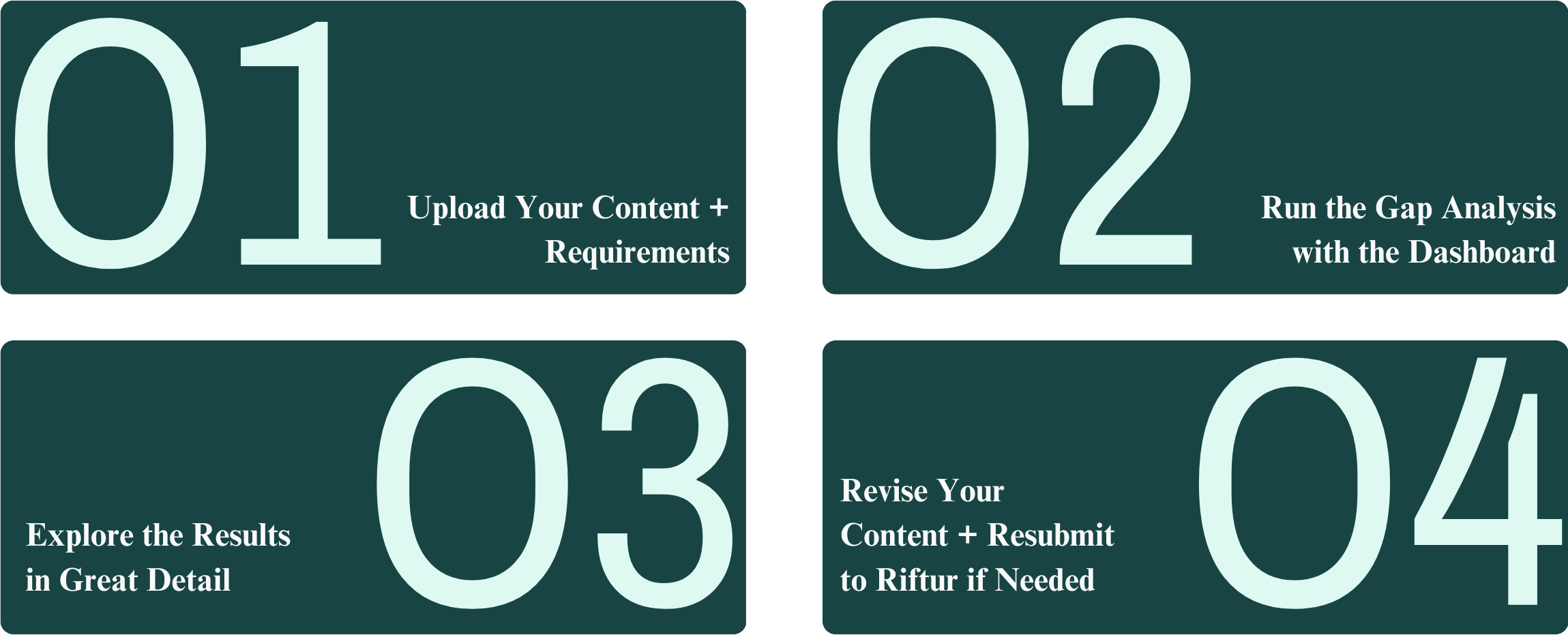
How to Use Riftur in 4 Steps
Examples of How Real Teams Use Riftur
Government Proposals
Use Riftur across every stage of proposal development, from early drafts to final submission, to ensure your content fully meets solicitation requirements and closes gaps before evaluation. Compare draft sections against instructions (Section L), evaluation criteria (Section M), compliance matrices, statements of work, and more to surface missing elements and strengthen your proposal. Riftur supports a wide range of government documents, including but not limited to white papers, full proposals, RFP/RFQ responses, solicitations, technical volumes, management volumes, and capability statements.
Draft Document
Reference Criteria
Output Analysis
The comparison maps the white_paper.pdf draft against the explicit structural, content, and formatting requirements defined in WPReqs.pdf for the Provably Secure System Assessment Event White Paper. Each requirement area is treated as a discrete evaluation dimension. The analysis identifies fully satisfied requirements, partial coverage, and compliance gaps, distinguishing mandatory content elements from mandatory formatting constraints. Risks focus on evaluability, compliance rejection, and ambiguity around implicit assumptions. Resulting tables resemble standard proposal compliance matrices and risk registers to support targeted remediation prior to submission.
White Paper Requirement Compliance Matrix
Detailed Content Gap & Enhancement Analysis
Risk and Compliance Impact Assessment
Audits & Regulatory Reviews
Test documentation against published standards to ensure nothing gets flagged late.
Draft Document
Reference Criteria
Output Analysis
The comparison maps explicit requirements from requirements.pdf to observable behaviors in user_manager_code.py, focusing on GDPR compliance, ISO/IEC 27001 & SOC 2 security controls, software development quality practices, and industry-specific FinTech/PCI-DSS obligations. The analysis evaluates how personal and sensitive data is handled, how files and resources are managed, the presence of unsafe execution functions, and the adequacy of logging and audit trails. Each requirement is classified as compliant, partially compliant, or non-compliant, with risk-based findings to support remediation planning.
Requirement-to-Code Compliance Mapping
Personal & Sensitive Data Handling Analysis
File Handling & Resource Management vs ISO/IEC 27001 / SOC 2
Unsafe Functions & Execution Security
Logging, Audit Trails & Monitoring
Software Quality & Maintainability Requirements
Risk & Remediation Prioritisation
M&A Due Diligence
Align technical or process documentation between organizations, flagging critical differences that need harmonization.
Draft Document
Reference Criteria
Output Analysis
The comparison maps Company B’s due diligence checklist to the capabilities and practices described in Company_A_Tech_Overview_Extended.pdf. Each checklist dimension—including infrastructure, data governance, application architecture, DevSecOps, observability, software quality, compliance, and intellectual property—is evaluated for explicit alignment, partial coverage, or gaps. Concrete tooling evidence (e.g., Terraform, EKS, Prometheus, Grafana, Snyk, Secrets Manager) is tied to the corresponding checklist controls. Missing or unspecified items (e.g., data retention policies, API versioning, distributed tracing, test coverage, ADRs, IP ownership documentation) are marked as gaps. The tables follow standard technical due diligence mapping and risk assessment patterns for M&A transactions.
Requirement Coverage Mapping – Company_B_Due_Diligence_Checklist_Extended.pdf vs Company_A_Tech_Overview_Extended.pdf
Thematic Alignment Summary
Gap Detail and Risk Assessment
Internal Process Alignment
Compare two versions of standard operating procedures, security policies, or training manuals and identify divergence points.
Draft Document
Reference Criteria
Output Analysis
This analysis aligns Corporate_Security_Policy_v2_Expanded.pdf (v2.5) as the target security standard against Corporate_Security_Policy_v1_Expanded.pdf (v1.0) as the legacy baseline. Controls are compared across purpose/scope, governance, access management, data protection, monitoring, and incident response. For each requirement in v2.5, the v1.0 treatment is assessed as aligned, partially aligned, or a gap. The analysis identifies strengthened or newly introduced controls in v2.5, highlights weaker or missing requirements in v1.0, and maps risk implications and remediation steps. The structure follows ISO 27001/SOC 2-style control gap assessments and is suitable for internal policy modernization planning and audit preparation.
Section-by-Section Control Alignment
Control Gap Register (v2.5 Expectations vs v1.0 Policy)
Risk-Oriented Impact Assessment (From v1.0 Relative to v2.5)
Overlap & Strength Reuse Opportunities
Education & Training
Evaluate student work against rubrics, professional standards, or accreditation criteria at scale and with clarity.
Draft Document
Reference Criteria
Output Analysis
Document_B_Rubric_Long.pdf is treated as the grading rubric and Document_A_Student_Essay_Long.pdf as the student submission. Rubric criteria are normalized across Content Understanding, Critical Thinking & Analysis, Structure & Organization, Writing Quality & Mechanics, Use of Sources, and Accreditation & Professional Standards. Each rubric bullet is evaluated against explicit evidence found in the essay. The essay demonstrates strong topical understanding and organized structure but exhibits clear weaknesses in critical analysis depth, citation use, thesis clarity, and mechanical accuracy due to OCR artifacts. The tables highlight where rubric expectations are met, partially met, or not met, and identify actionable improvements aligned with academic writing standards and rubric criteria.
Rubric Criteria Evaluation by Category
Criterion Coverage Summary
Gaps and Improvement Actions
© 2025 Riftur — All Rights Reserved