
Internal Process Alignment with Riftur
By Jude Canady

Common Problems with Internal Process Alignment
Internal process alignment sounds simple on paper, but in practice it’s one of the most persistent operational headaches companies face. Policies evolve constantly due to regulatory changes, security incidents, or internal growth, yet those updates rarely propagate cleanly across every team. One department may be referencing a newer policy version, while another is still operating off an outdated PDF saved to a shared drive months ago. Over time, these small discrepancies compound into real risk, especially when audits or incidents force teams to justify which version was authoritative. The lack of a single source of truth creates confusion, rework, and unnecessary tension between teams that are all trying to do the right thing. Tracking differences between policy versions is particularly painful when documents grow large and complex. Security, compliance, HR, and IT policies often span dozens or hundreds of pages, making manual comparison slow and error-prone. Teams resort to ad-hoc methods like highlighting changes in Word or sending “summary of updates” emails that inevitably miss critical details. This makes it hard to confidently answer basic questions like what actually changed, why it changed, and whether the change was fully implemented. Without visibility into deltas, organizations lose trust in their own documentation. The cost of misalignment isn’t just theoretical; it shows up directly in time and money. Studies consistently show that compliance and security teams spend hundreds of hours per year preparing for audits, much of it dedicated to reconciling documentation inconsistencies and control gaps. In regulated industries, a single missed requirement can lead to failed audits, remediation projects, or regulatory penalties that dwarf the cost of doing alignment properly. Even outside of audits, misaligned processes slow down decision-making and increase operational friction. In short, when policies drift out of sync, the business pays for it repeatedly.
Syncing Versions with Riftur
This is one of the core problems that Riftur was built to solve. Riftur provides a structured way to compare, track, and understand changes between document versions without relying on manual reviews or tribal knowledge. Instead of guessing what changed between v1.0 and v2.5 of a policy, teams get clear, auditable mappings that show coverage, gaps, and material differences. This turns policy updates from a stressful scramble into a controlled, repeatable process. By automatically aligning documents across versions, Riftur removes ambiguity from internal processes. Teams can see where requirements were strengthened, where language became more prescriptive, and where older versions fall short of new standards. This is especially valuable for organizations dealing with frameworks like ISO 27001, SOC 2, or NIST, where wording and parameters matter. Rather than debating interpretations, stakeholders can focus on remediation and implementation. Alignment stops being a bottleneck and starts becoming a strategic advantage. The real win, though, is the time and peace of mind teams get back. Security and compliance leaders no longer have to manually defend their documentation during audits or internal reviews. Engineering and IT teams gain clarity on what controls actually apply to them today, not last year. Leadership gets confidence that policies are consistent across the organization and enforced uniformly. When everyone knows the documents are in sync, energy shifts from firefighting to forward progress.
Use Case: Turning Policy Chaos into Clarity
To assess Riftur's performance on this task, here is a practical example of this challenge, which arises when comparing two versions of a corporate security policy: one at version 1.0 and a more mature version at 2.5. The newer policy introduced stricter requirements around MFA, log retention, incident response timelines, and governance cadence, while the older version allowed exceptions and “best-effort” practices. Without structured alignment, these differences would be easy to miss, leaving teams falsely assuming compliance. This kind of version drift is common in growing organizations and often goes unnoticed until an audit or incident exposes it. Using Riftur, one is able to map each requirement in the newer policy directly to language in the older one, clearly labeling items as covered, partially covered, or outright gaps. For example, MFA enforcement shifted from optional to mandatory, log retention expanded from 30 days to 12 months, and incident reporting timelines tightened dramatically. These weren’t subtle changes; they represented meaningful increases in security posture and operational expectations. The alignment output made those deltas impossible to ignore and easy to prioritize . More importantly, the resulting gap and risk registers give a concrete action plan. Instead of vague statements like “improve logging” or “strengthen access controls,” stakeholders are provided with specific remediation steps tied directly to policy language. This enables security leaders to justify investments in tooling and process changes with clear evidence, while compliance teams gain audit-ready documentation without weeks of manual prep. What could have been months of back-and-forth became a focused, defensible improvement effort. See the following images for partial results produced by Riftur for the example documents described above.
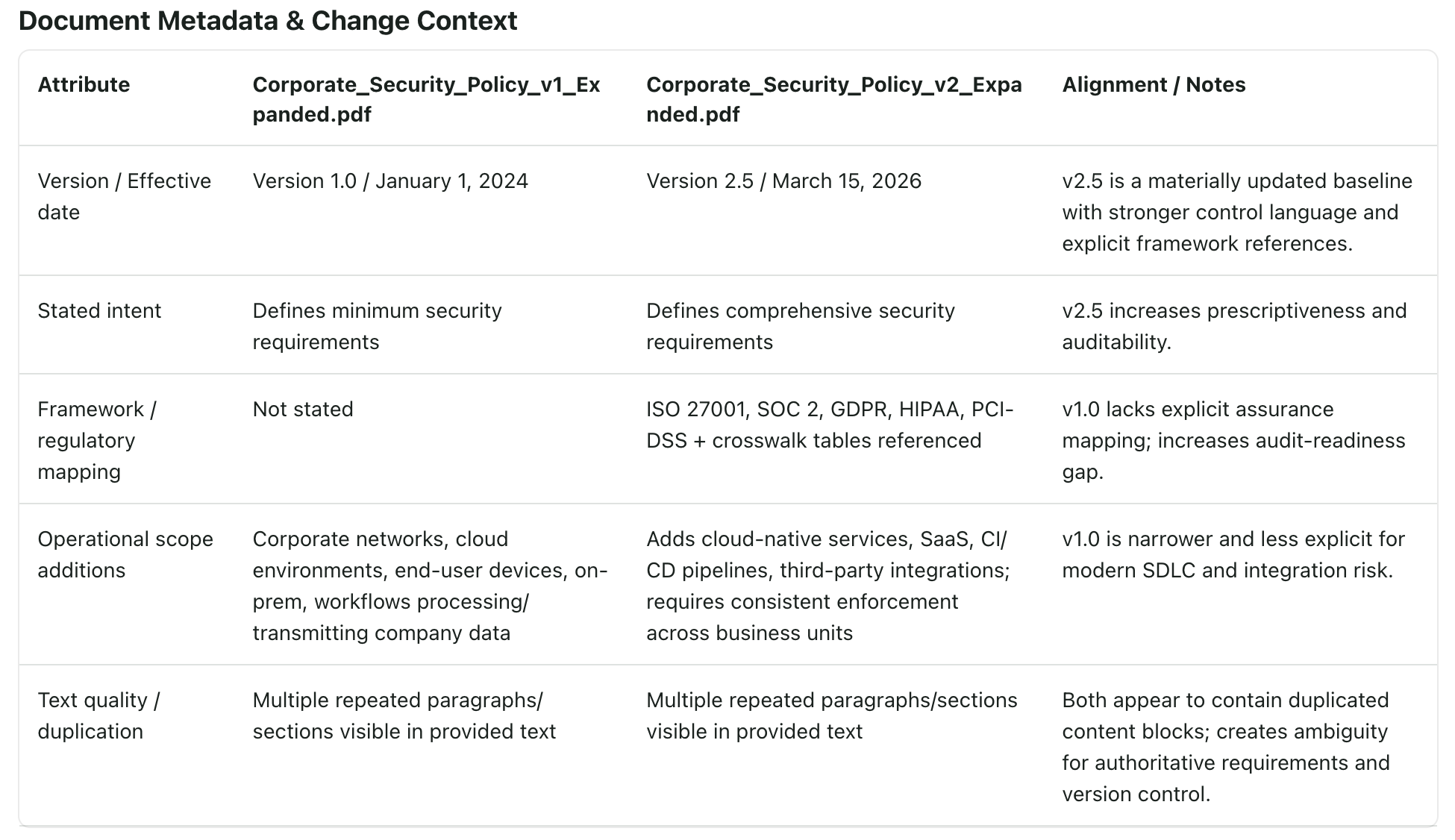
High-level summary of alignment review.
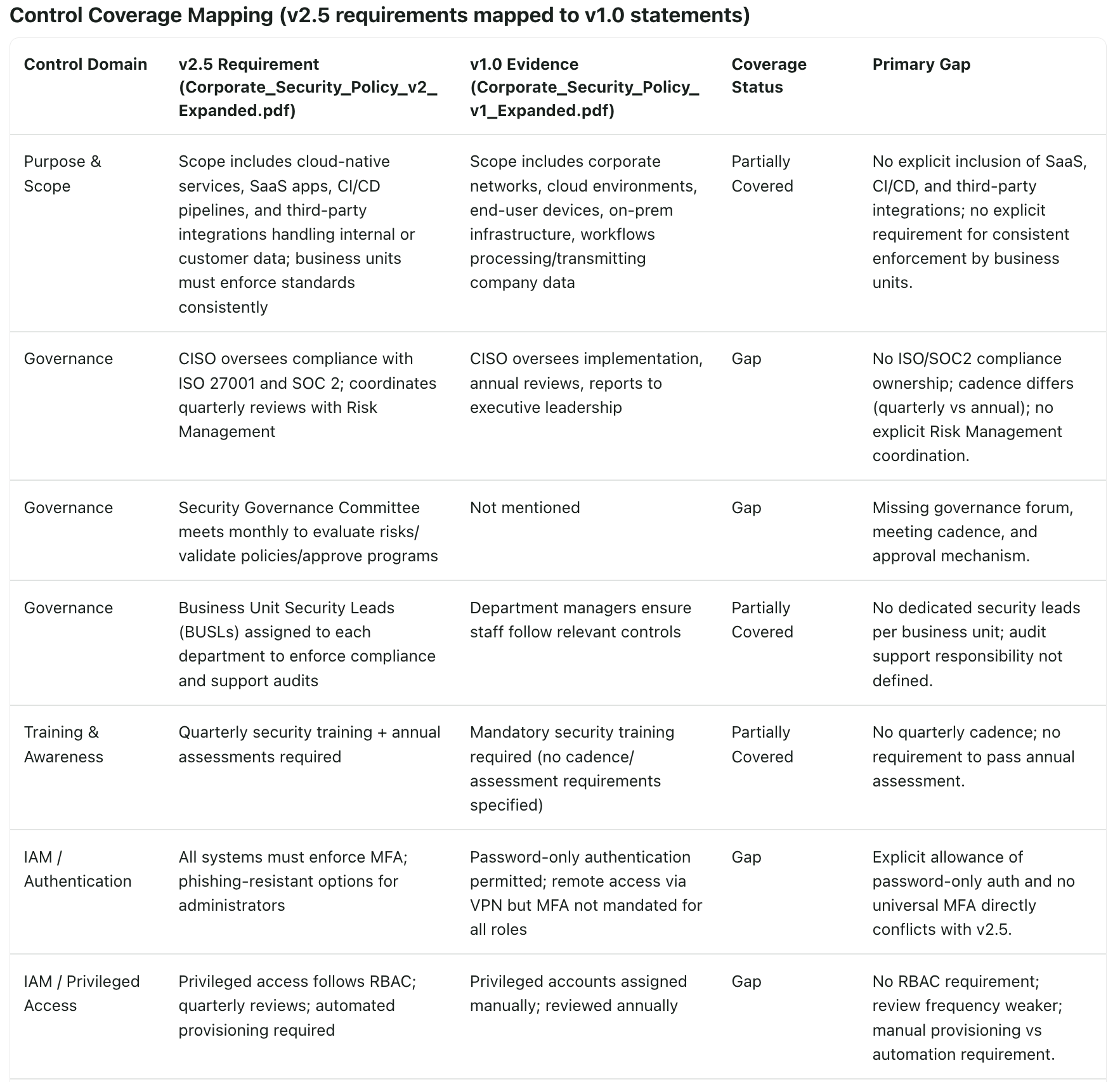
Gap matrix between policy versions.
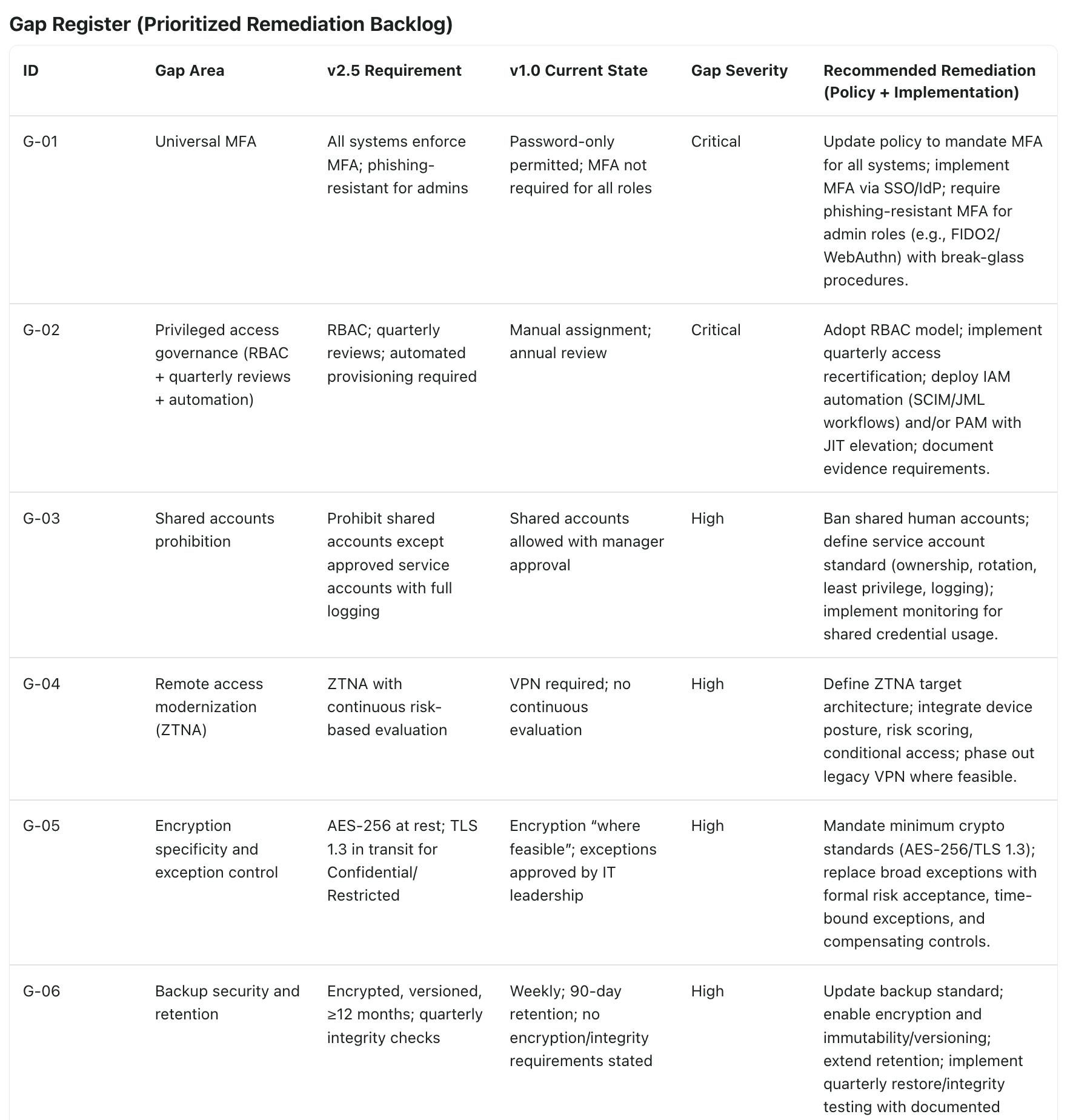
Granual gap register between document versions.
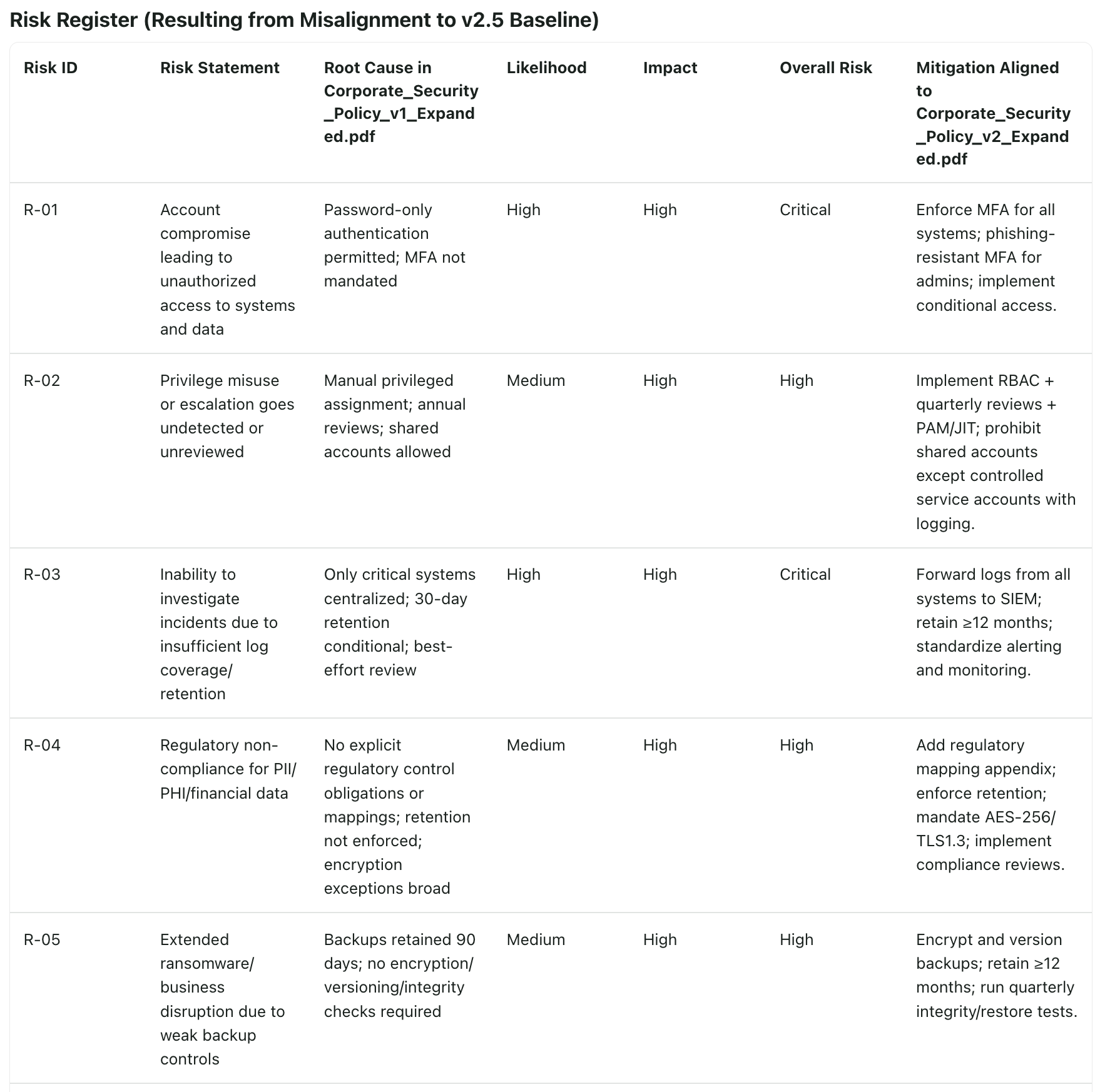
Risk register identified from the two policy versions.
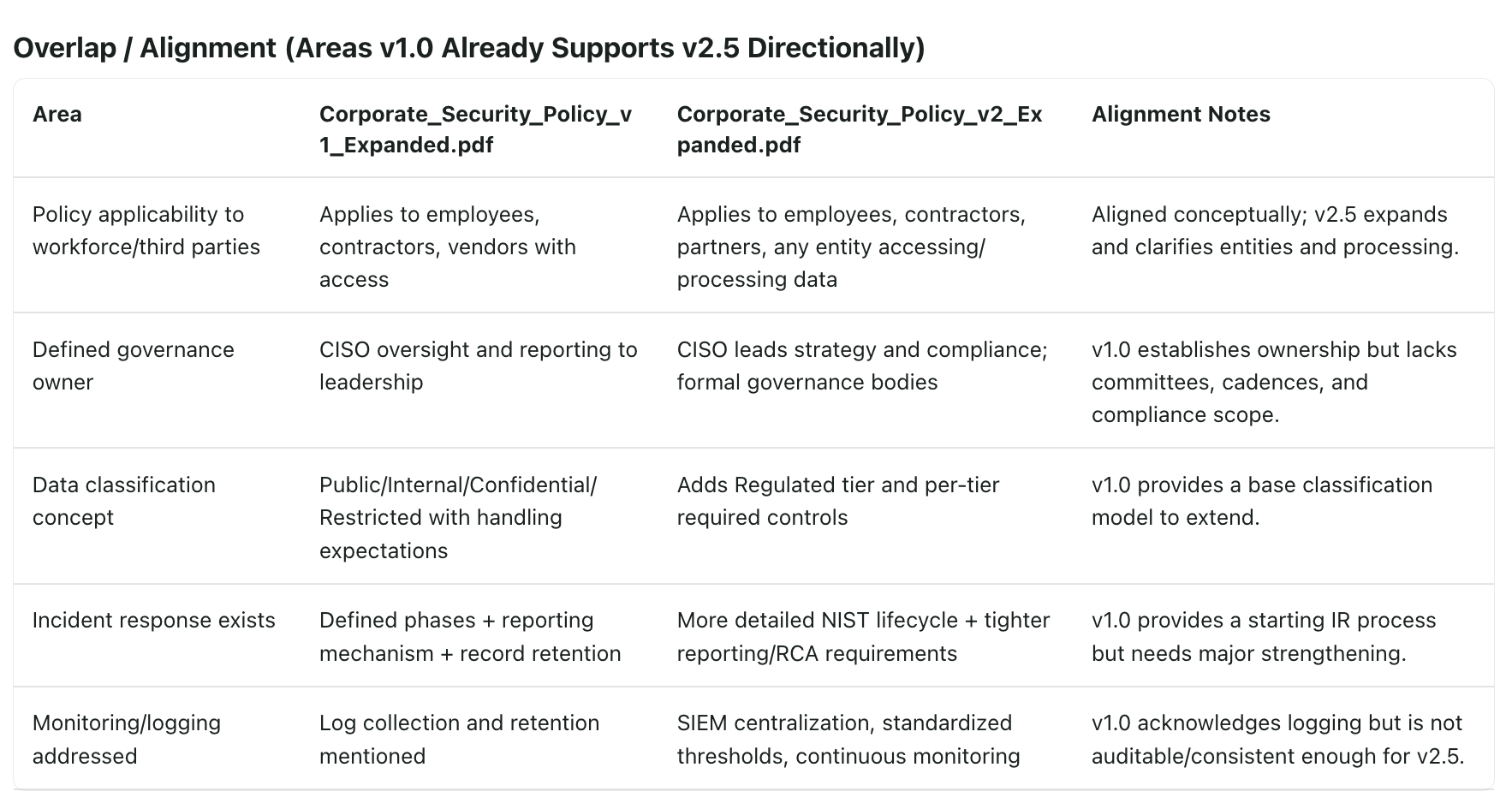
Alignment summary.
Align for the Ages
Process alignment isn’t glamorous, but it’s foundational to scaling securely and efficiently. When policies drift out of sync, organizations lose time, increase risk, and create unnecessary internal friction. The good news is that this problem is solvable with the right approach and tooling. Clear visibility into document differences changes alignment from a reactive chore into a proactive discipline. If your team is tired of chasing policy versions, reconciling conflicting requirements, or scrambling before audits, it may be time to rethink how you manage alignment. Riftur helps teams keep their processes consistent, auditable, and up to date without the manual pain. Sign up today to bring clarity back to your documentation and confidence back to your operations.
If you have questions, feedback, or want to learn more about how Riftur is used, contact us. You can also visit our home page at riftur.com to start testing the platform for your use case. Read other posts on our blog for related topics and updates on Riftur.
© 2025 Riftur — All Rights Reserved