
Scope Creep in Proposal Development
By Jude Canady
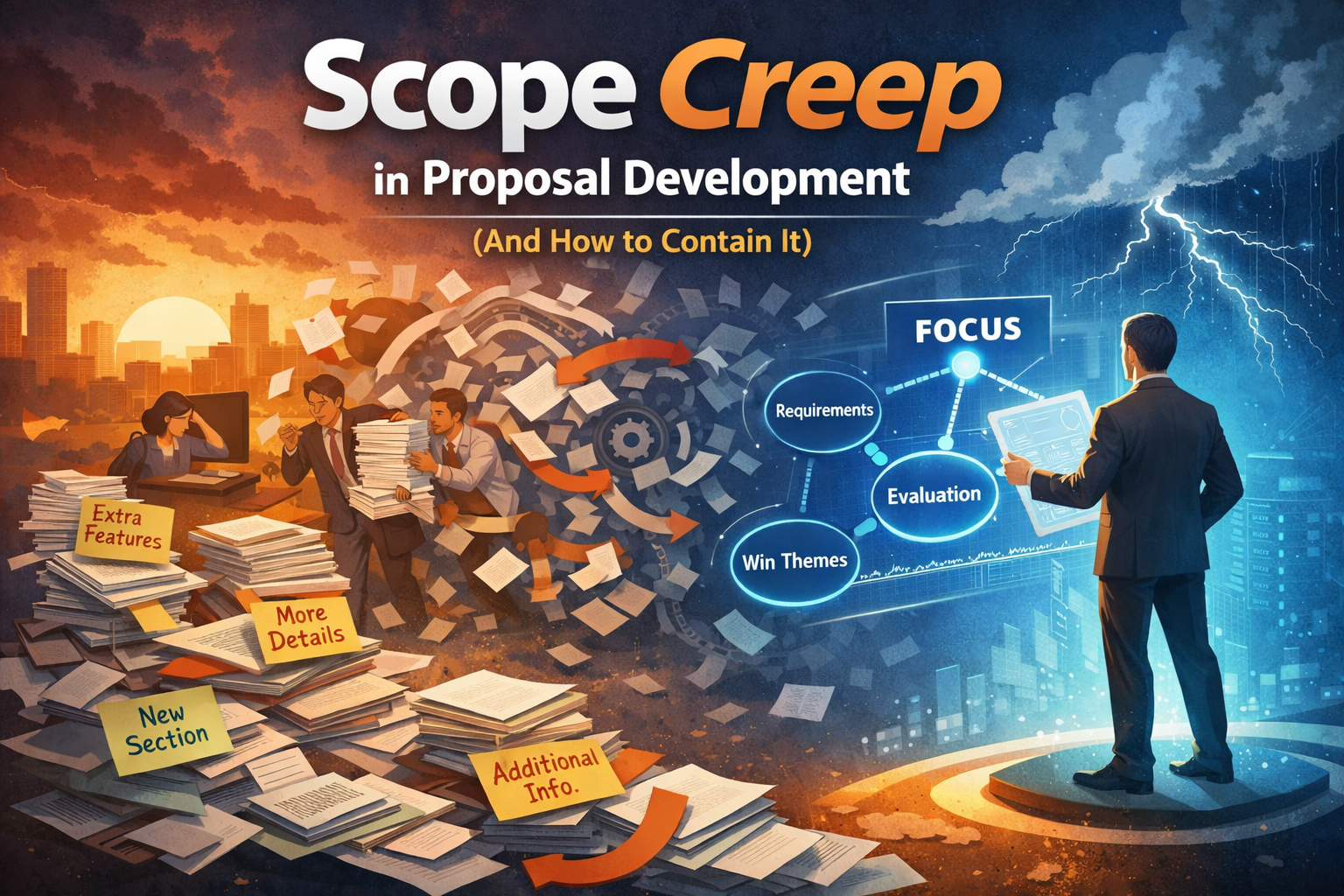
The Quiet Expansion
Scope creep in proposal development rarely looks like a problem at first. It appears as helpfulness. A writer adds a paragraph to clarify an assumption. A subject matter expert expands a section to explain a capability in more depth. A reviewer asks for an additional example “just to be safe.” None of these actions feel risky in isolation, and most are driven by good intentions. Yet over time, these small expansions accumulate into a proposal that is noticeably larger, denser, and harder to control than originally planned. Unlike schedule slips or compliance gaps, scope creep is difficult to detect because it does not present as an obvious failure. The proposal still contains strong content. It still references requirements. It may even look more impressive at a glance. The danger lies in what gets lost as content grows: focus. Strong proposals succeed because they tell a disciplined story about why a specific solution best satisfies a specific set of needs. As scope expands, that story becomes diluted. The proposal starts responding to imagined expectations rather than actual ones, and the narrative center of gravity slowly drifts. This drift creates a subtle but powerful form of risk. Teams spend more time managing volume than sharpening arguments. Reviewers struggle to identify what is essential versus what is merely present. Proposal managers sense that the document is bloated but lack a clear basis for cutting content. By the time the problem is acknowledged, scope creep is deeply embedded, and reversing it feels more dangerous than leaving it in place.
It Just Creeps In
At its core, proposal scope creep is a byproduct of ambiguity. Requirements rarely specify exactly how much depth is expected in a response. They describe what must be addressed, but not how extensively. This leaves room for interpretation, and different contributors naturally interpret differently. Some respond minimally, focusing on direct answers. Others infer unstated expectations and build broader narratives around them. Both approaches coexist, and without an explicit mechanism to reconcile them, the proposal grows outward. Risk aversion compounds the problem. Proposal teams operate in high-stakes environments where omission feels more dangerous than excess. It is psychologically easier to add another paragraph than to justify removing one. Over time, the proposal becomes a hedge against every conceivable evaluation concern. Content is added not because it clearly advances the win strategy, but because it might prevent a potential weakness. This defensive posture gradually replaces intentional design. Internal dynamics also play a role. Executives want strategic positioning emphasized. Engineers want technical rigor. Business development wants differentiators highlighted. Marketing wants polished messaging. Each group pushes content into the proposal based on its own priorities, and all of them are reasonable. Without a shared, enforceable definition of scope, these inputs stack rather than balance. The proposal becomes an aggregation of perspectives instead of a coherent argument.
Complexity Cascades
As scope expands, complexity increases exponentially. More content means more internal dependencies between sections. A change in one area now ripples into multiple others. Writers must track more cross-references. Reviewers must reconcile more overlaps. Compliance teams must verify more relationships. The proposal becomes fragile, even if no single section appears problematic. This fragility shows up late. Early drafts often feel manageable because teams are still adding content. The real pain emerges during final reviews, production checks, and compliance scrubs. That is when teams realize how much material they are carrying and how little time they have to rationalize it. Decisions become reactive. Instead of asking what makes the proposal stronger, teams ask what they can safely leave alone. The bar for improvement rises, while the tolerance for risk drops. There is also a cultural cost. When scope creep becomes normalized, contributors stop expecting clarity. They assume everything is provisional and that more content will always be requested. Proposal managers shift from strategic leaders to traffic controllers. Reviews devolve into surface-level edits because deeper restructuring feels too dangerous. Over time, the organization accepts bloated proposals as inevitable, even though they quietly undermine competitiveness.
Lasso the Scope before It Escapes
Containing scope creep requires changing how scope is defined and how it is enforced throughout proposal development. Scope is not the number of sections, pages, or words in a proposal. Scope is the set of intents the proposal must satisfy: customer requirements, evaluation criteria, and internal win themes. Each piece of content should exist to serve one or more of those intents, and anything that does not clearly map back to them is, by definition, out of scope. This reframing shifts conversations in productive ways. Instead of debating whether a paragraph is “good,” teams ask whether it improves alignment to an intent that matters. Instead of arguing about personal preferences, reviewers focus on coverage quality. Instead of freezing text early to prevent growth, proposal managers allow iteration within well-defined intent boundaries. Riftur is designed around this alignment-centric view of proposal development and enables containment through confidence rather than restriction. Rather than treating proposals as static documents, Riftur evaluates how current content aligns to source requirements and internal objectives. Teams place requirements, evaluation criteria, or win themes on one side and proposal materials on the other, and Riftur analyzes how well the meaning and intent of each requirement is addressed across the evolving content. When a writer adds or modifies text, the system immediately shows whether alignment strengthens, weakens, or remains unchanged, making scope visible in a way traditional outlines and matrices cannot. With alignment continuously visible, scope creep becomes detectable early. If new content does not improve alignment to an existing intent, it stands out. If it introduces an implicit new intent, that becomes clear as well. Documents can change, but alignment remains visible. Scope boundaries are defined by intent, not by fragile outlines or page limits. The result is a proposal that stays focused even as it evolves, and over time teams internalize this discipline. Scope creep does not disappear because people become more careful. It disappears because they finally have a reliable way to see what matters and what does not.
If you have questions, feedback, or want to learn more about how Riftur is used, contact us. You can also visit our home page at riftur.com to start testing the platform for your use case. Read other posts on our blog for related topics and updates on Riftur.
© 2025 Riftur — All Rights Reserved