
Tightening Loose BAA Requirements
By Jude Canady
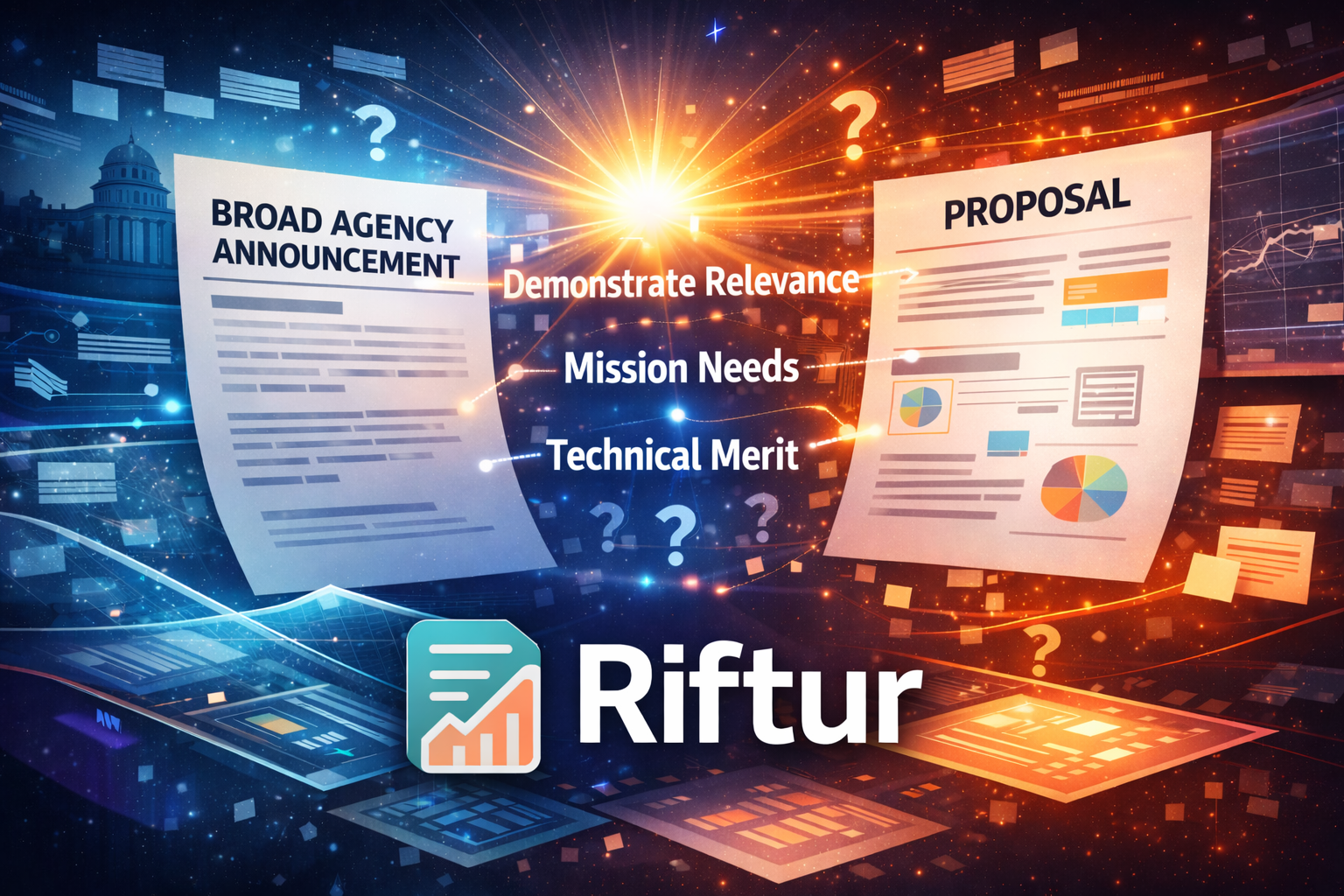
The Challenge of Broad Agency Announcements
Broad Agency Announcements are intentionally written to be flexible. Agencies use them to invite innovation rather than prescribe exact solutions, which means requirements are often high-level, conceptual, and open to interpretation. Instead of clear pass-or-fail criteria, BAAs rely on phrases like “demonstrate relevance,” “address mission needs,” or “show technical merit.” For organizations responding to them, this flexibility creates uncertainty. Teams must infer expectations from limited guidance and align complex technical documentation to loosely defined goals. Small differences in interpretation can significantly affect how a proposal is evaluated. As a result, proposal development becomes less about execution and more about interpretation.
Why Manual Interpretation Breaks Down
Most teams address loose BAA requirements through manual reading and discussion. Subject matter experts review the announcement, highlight key sections, and debate what the agency is really asking for. Proposal writers then attempt to reflect that interpretation across narratives, technical volumes, and supporting documents. This process is inherently subjective and difficult to standardize. Interpretations vary between reviewers, and alignment decisions are rarely documented in a structured way. Confidence often substitutes for evidence of coverage. Gaps are usually discovered late, when time and options are limited. Manual interpretation also scales poorly as proposal complexity increases. As documents grow longer, it becomes harder to track how each section supports the announcement’s intent. Cross-referencing language across volumes is time-consuming and error-prone. Teams rely heavily on individual experience rather than repeatable analysis. When deadlines compress, reviews become superficial. Important assumptions go unchallenged. The same types of misalignment recur across submissions, even when teams are highly experienced. This breakdown is especially costly in BAA environments because feedback is limited. Unlike traditional procurements, agencies rarely provide detailed explanations of why a proposal missed the mark. Teams are left guessing which interpretations resonated and which fell flat. Lessons learned remain informal and incomplete. Over time, organizations repeat the same patterns without realizing it. The looseness of the announcement amplifies the consequences of weak internal review. What feels like flexibility during writing becomes risk during evaluation.
How Riftur Brings Structure to Ambiguity
Riftur addresses the core challenge of BAAs by focusing on semantic alignment rather than rigid checklists. Teams place BAA language on one side and proposal or technical documentation on the other. Riftur evaluates how well the meaning and intent of the announcement are addressed across the materials. Instead of forcing artificial precision, it highlights degrees of alignment. Areas that clearly support agency objectives are identified early. Areas that rely on weak inference or partial coverage are surfaced for review. This creates a structured view of how interpretation maps to the announcement. The output is consistent and repeatable, which is critical when requirements are loosely defined. Teams no longer rely solely on subjective confidence to assess readiness. Alignment decisions become visible, reviewable, and defensible. This does not replace expert judgment or strategic thinking. It removes ambiguity from the mechanics of review. By making alignment explicit, Riftur allows teams to focus on improving clarity rather than debating intent late in the process. The value of Riftur is not in narrowing creative responses, but in strengthening their foundation. BAAs reward originality, but originality still must be clearly connected to mission needs and evaluation themes. Riftur allows teams to test whether innovative ideas are explicitly supported by the announcement’s language. Alignment checks can happen throughout proposal development, not just at the end. This encourages earlier corrections and clearer articulation of relevance. Assumptions are surfaced while there is still time to address them.
Silencing Uncertainty
Responding to Broad Agency Announcements will always involve interpretation. What changes is how systematically that interpretation is evaluated and refined. Riftur turns alignment from an informal judgment into a repeatable process. Teams gain clarity on where proposals are strong and where assumptions may be unsupported. This reduces last-minute rewrites and lowers stress near submission deadlines. Proposal development becomes more predictable without becoming rigid. Over time, that consistency compounds across submissions. Teams spend less effort rediscovering how to interpret loosely written requirements. Reviews become faster and more constructive. Lessons learned are captured in structured outputs rather than tribal knowledge. Confidence increases because alignment is demonstrated, not assumed. Proposal teams shift from reactive fixes to deliberate improvement. In an environment defined by ambiguity, this repeatability becomes a competitive advantage. Organizations can respond to BAAs with greater confidence even when requirements remain abstract. Innovation is preserved, but it is backed by clear, defensible alignment. Review cycles become calmer and more intentional. The process supports learning instead of guesswork. Loose requirements stop being a liability and become something teams know how to manage.
If you have questions, feedback, or want to learn more about how Riftur is used, contact us. You can also visit our home page at riftur.com to start testing the platform for your use case. Read other posts on our blog for related topics and updates on Riftur.
© 2025 Riftur — All Rights Reserved