
Version Control Nightmares: How to Prevent Last-Minute Proposal Chaos
By Jude Canady
Welcome to Version Sprawl
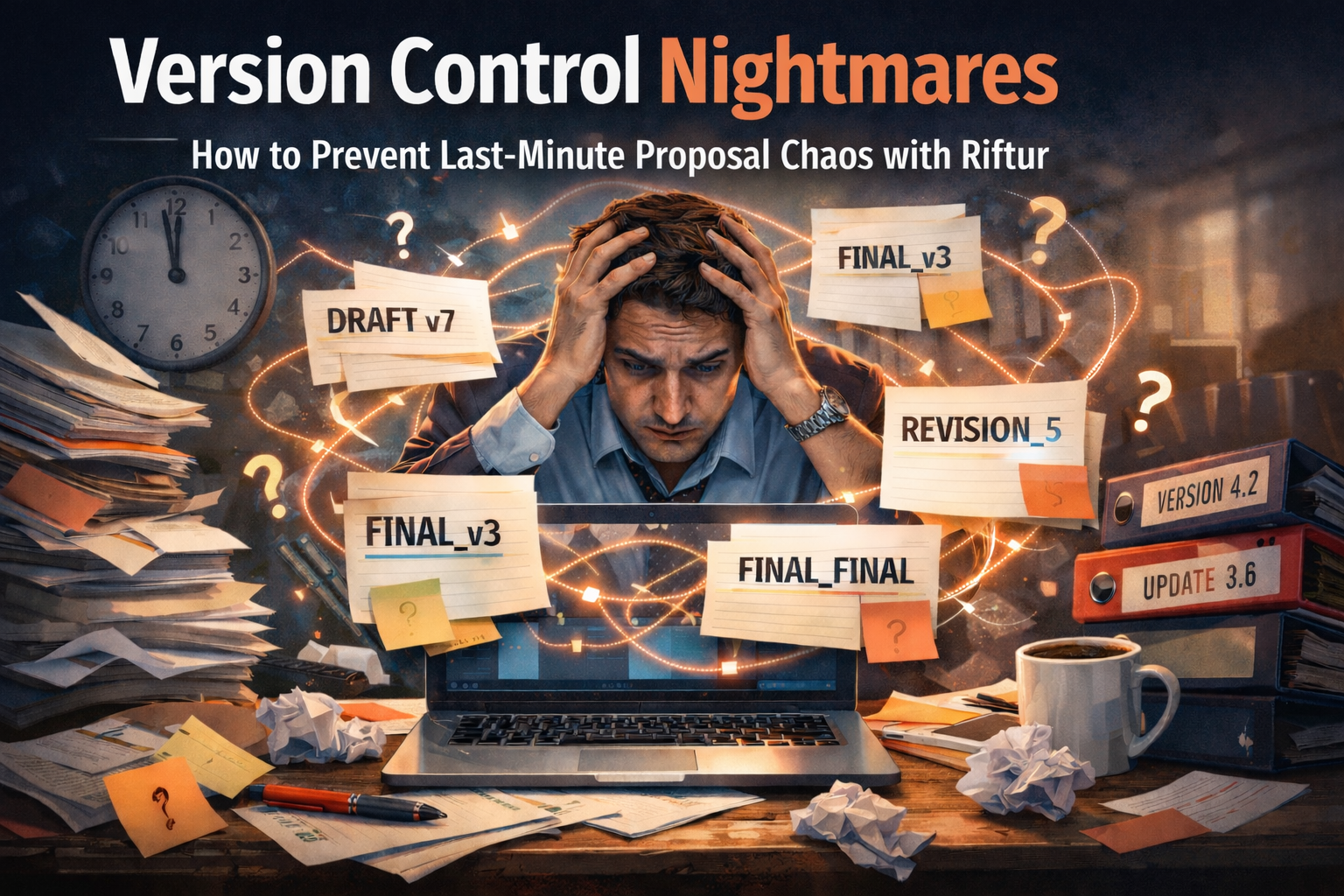
Large proposals rarely fail because teams lack expertise. They fail because teams lose control of information. As deadlines approach, files multiply. Drafts are duplicated, renamed, and passed between contributors. Comments are embedded, copied into emails, or rewritten into new documents. Multiple “final” versions circulate at the same time. No single person is fully certain which file represents the authoritative state of the proposal. This version sprawl creates an environment where mistakes are easy and detection is hard. Writers update language in one document but not in others. Graphics teams revise figures based on outdated text. Compliance matrices reference sections that no longer exist. Reviewers provide feedback on drafts that are already obsolete. Each handoff introduces risk, and that risk compounds as submission approaches. The result is familiar to most proposal managers: last-minute chaos. Teams scramble to reconcile differences, confirm what has changed, and decide which edits are safe to incorporate. Time that should be spent improving quality is consumed by hunting for the “right” version.
Tradition Trips Us Up
Most organizations attempt to manage versions through file naming conventions, shared folders, and manual check-in/check-out rules. While these approaches work in small, simple projects, they break down under the pressure of complex proposals. File names cannot convey meaning. A title like “Tech_Volume_v12_FINAL2_REALLYFINAL.docx” communicates nothing about what changed or why. Shared drives do not prevent parallel edits. Two contributors can easily download the same file, make conflicting changes, and upload competing versions. Email attachments further fragment the ecosystem. Even systems with formal version histories focus on tracking document changes, not proposal intent. They show what text was modified, but not whether those modifications improved alignment, introduced gaps, or contradicted other sections. Proposal managers are left to infer impact manually. As complexity grows, this inference becomes unreliable. The core problem is that traditional version control treats proposals as static documents. In reality, proposals are living arguments. Each change affects narrative coherence, compliance posture, and alignment to requirements. Without visibility into those relationships, version control becomes bookkeeping rather than risk management.
Cost of Late Discovery
Version problems rarely surface early. They reveal themselves during final reviews, production checks, or compliance scrubs. By then, options are limited. Teams must choose between rushing fixes or accepting known weaknesses. This erodes trust in the process and in the team in general. Contributors become hesitant to make improvements because they fear overwriting someone else’s work. Reviewers lose confidence that their comments will be implemented correctly. Proposal managers spend increasing amounts of time policing documents instead of guiding strategy. This dynamic shifts the culture of proposal development. Instead of proactive refinement, teams operate defensively. The process becomes about avoiding mistakes rather than building the strongest possible response.
Focus on Alignment State, Not Version
Preventing version chaos requires reframing what “control” actually means. Control is not knowing which file is newest or which folder holds the latest draft. Control is knowing whether the proposal, as it exists at this moment, is aligned to its requirements, evaluation criteria, and internal strategy. Riftur approaches version management at this semantic level. Rather than treating documents as isolated artifacts, Riftur evaluates how proposal content aligns to source requirements and internal intent. Teams place requirements, objectives, or evaluation criteria on one side and proposal materials on the other, and Riftur analyzes how well the meaning and intent of each requirement is addressed across the current content. When a writer updates a section, the question is no longer “which file changed?” It becomes “did this change improve or degrade alignment?” Riftur surfaces the answer immediately, highlighting where coverage remains strong and where it weakens or disappears. The result is a persistent alignment state that transcends individual document versions and provides continuous visibility into proposal health. With alignment visible, changes become safer to make. Contributors can experiment, refine language, and reorganize sections without guessing about downstream impact. If a revision introduces a gap, it is surfaced early. If it strengthens coverage, that improvement is visible to reviewers. Proposal managers no longer need to freeze documents prematurely out of fear. They can allow iteration later in the cycle because they have objective feedback on whether alignment is being preserved. Reviews shift from “what changed?” to “what improved?” Collaboration across volumes becomes simpler as well. Technical, management, and past performance teams can work in parallel while Riftur continuously evaluates how their content maps back to shared requirements and themes. Cross-volume inconsistencies appear as alignment anomalies rather than buried text differences, reducing last-minute risk.
Wake Up
Version control nightmares are symptoms of a deeper issue: lack of visibility into proposal integrity. File-level tracking cannot solve that problem on its own. What proposal managers need is continuous insight into whether the evolving content still supports the intended story and satisfies requirements. Riftur provides that insight by making alignment the primary control mechanism. Documents can continue to change, but proposal integrity remains measurable. Chaos gives way to predictability, and over time, this predictability compounds. Teams develop confidence in their ability to iterate without destabilizing the proposal. Reviews become faster and more focused. Lessons learned are grounded in observable alignment patterns rather than anecdotes. Last-minute proposal chaos does not disappear because teams work harder. It disappears because teams gain a better way to see what matters.
If you have questions, feedback, or want to learn more about how Riftur is used, contact us. You can also visit our home page at riftur.com to start testing the platform for your use case. Read other posts on our blog for related topics and updates on Riftur.
© 2025 Riftur — All Rights Reserved